- SIX ACCIDENTAL MOMENTS ON GREAT RECORDS / OH COMELYThe crucial difference between songs and records is that a song is an idea and a record is a thing. The clue’s in the name: a record is a record of its own creation. Even with the impact of multitrack recording and digital workstations, a record is a document of a place and a time. A fixed point. Did the singer have a cold that day? How did the instruments sound? Were the band getting along? Where were the mics placed? Did Sting accidentally sit on a piano? “A Day in the Life”, The Beatles
If you catch the author of these words in a particularly grandiloquent mood he will argue (at tiresome length) that A Day in the Life is the high-water mark of 20th century music – an ambitious, ambiguous masterpiece that’s as close to transcendent as pop has managed to achieve. After a rising orchestral glissando, the song climaxes with an E-major chord played simultaneously on three pianos and a harmonium. As the note rings out for forty triumphant seconds, the vibrations drifting off into the universe, Ringo Starr’s shoe squeaks as he shifts his weight in his seat. Improbably, it’s the perfect ending: an art form’s apogee, recorded over 34 hours, and in its final moments you hear Ringo fidget.
“Mack the Knife”, Ella Fitzgerald
Kurt Weill’s standard Mack the Knife has been recorded by so many artists that you probably have a version of it out there somewhere, but few iterations compare to Ella Fitzgerald’s 1960 live performance. After the first verse Fitzgerald went completely blank, but managed to style it out, singing “Oh what’s the next chorus to this song now/this is the one now/I don’t know/but it was a swinging tune and it’s a hit tune/So we tried to do Mack the Knife” and continuing to make up two further verses without missing a beat. Fitzgerald was such a pro that she – by her own in-song admission – made “a wreck” and still ended up winning two Grammies for the performance.
“Black Country Woman”, Led Zeppelin
A common childhood memory: the weather is glorious and your teacher, in a beatific mood, agrees to have class outdoors for the day. For adults, unfortunately, the insect-alluring reality rarely matches the fantasy. Led Zeppelin learned this when they decided to use the Rolling Stones’ mobile studio (like a mobile library but containing a mixing desk and drugs instead of paperbacks) to record Black Country Woman in Mick Jagger’s garden. As soon as they started taping a plane appeared overhead, but they chose to keep this in along with their discussion about keeping it in. This ended better, at least, than the other occasion they attempted recording in a garden and Robert Plant was attacked by a flock of geese.
“Labyrinth”, Grouper
“Infested with self-pity and anger” following a break-up, in 2011 Liz Harris – the artist and musician known as Grouper – accepted a residency in the small Portuguese town of Aljezur. Alone for days at a time, she would take field recordings and walk miles through the ruins of old estates. After a storm brought a power cut, she sat at a piano in the dark and played an aching instrumental called Labyrinth. A note or two from the end, something happened: the power returned, and floating across came the sound of the microwave switching back on. Harris decided to leave the song how it was; the result is perhaps the most haunting, lonely microwave beep you’ll ever hear.
“30 Hours”, Kanye West
The perfectionism of Kanye West’s music stands in contrast to his self-sabotaging public impulsiveness, which is why something seemed different about The Life of Pablo. West – a recently-married new father, preoccupied by other creative interests – continued to fiddle with the album in the months following its release, unable to get it right. He was so distracted that in the middle of an improvised verse during the song 30 Hours his phone rings and, unbelievably, he actually stops to take the call. “Yo Gabe, I’m just doing an adlib track right now”, he says, the tape still rolling, “What’s up?” While the moment amuses, it’s hard to imagine the hungry young producer of a decade earlier being diverted by anything.
“Oh Comely”, Neutral Milk Hotel
Considering the (lovely) magazine that’s named after it (but we’re biased, don’t take our word for it), Oh Comely is far darker and stranger than you might expect – eight and a half minutes of mass graves and sitting inside a stranger’s stomach and wanting to save Anne Frank in some sort of time machine and adulterous fathers who “made fetuses with flesh-licking ladies while you and your mother were asleep in the trailer park”. Jeff Mangum had been asked to sing a verse as a soundcheck, but ended up performing the entire song in a single take. As he finished, his astonished collaborator Scott Spillane, standing in the sound booth, screamed “Holy shit!”. He speaks for us all.

Originally published in Oh Comely Issue Thirty-Eight. Illustration by Matsuo Reiko.
- MAE MARTIN / OH COMELY
It’s a compelling proposition: in her latest stand-up show Dope, Mae Martin details the significant addictions of her life, one by one. First, as a child she becomes obsessed with Bette Middler’s performance in Hocus Pocus, coaxing her parents into taking her to the cinema to see it over and over again. Her next fixation is live comedy, as she attends clubs around her native Toronto five nights a week, “a creep hanging around stage doors”. Then, at the age of 13, she becomes a stand-up herself, soon dropping out of school to focus on it entirely. A child in an adult world, Mae becomes addicted to pot and then cocaine. Still only in her late teens, she gets sober after her family learns that she’s been dealing drugs to supplement her income.
The presence of Bette Middler aside, Mae’s early years have the potential to be bleak, heavy subject matter, which perhaps explains the time delay in her work. “It seems to take me a decade to talk about things”, she observes, “My last show was about my childhood and puberty, and then this is about the period that came right after. I hadn’t felt ready before now. I hadn’t processed it”. Her tarrying is understandable: Mae felt it was crucial to get the tone exactly right. “I think audiences can sense when you’re not being honest. It’s difficult to find the balance – to not be too flippant while also making it funny. You want to make sure that you’re able to go to that dark place and then bring people out of it again, to feel really in control of it yourself”.
To meet this challenge Mae decided to initially write the whole show “like a TED talk”, without any jokes in it at all. She spent time researching addiction, becoming interested in the work of Dr Gabor Maté, a physician who argues for a broader definition of addiction beyond substances. “It was the first time I’d thought about how addiction is really a pattern of behaviour that’s in different parts of your life”, she says. Mae found her research provided a way to temper the darker material (“it’s funnier to talk about being addicted to Bette Middler than it is to talk about being addicted to cocaine”), but this was also useful on a personal level. “I didn’t realise that you can alter your brain chemistry with things like exercise. I’m now going to the gym for the first time in my life. When I was a teenager I just chose cigarettes over any sports or physical activity. I’m still working through it all. I think that comes across in the show; I don’t really know the answers and it’ll probably be an ongoing thing forever, but that process is valuable. I haven’t had severe addiction problems in so long and I’m pretty vigilant about it, but it’s definitely something that comes up elsewhere in my life. Recognising that has been helpful”.

One of Dope‘s central arguments is that it’s important to understand the positive effects of an addiction as well as the negative ones, to locate what problem someone is attempting to deal with via their addiction. She uses the example of comedy in her own life: “When I found comedy it was filling a certain need, and that’s not a healthy relationship to have with anything. I felt like such an outsider and then I discovered this community of people who were not only openly saying what made them weird and gross and embarrassing but were actually being applauded and rewarded for it. It was such a revelation and I became obsessed. It’s all I would think or talk about. That was pretty damaging to me. It was less physically dangerous than a substance, but just as consuming”.
Although her obsession with comedy prefigured the burdensome addiction to come, Mae is equivocal on the consequences of starting her career so early. “I went through puberty on stage. I did the worst comedy. Thank God that YouTube wasn’t a thing and people weren’t filming on smartphones back then because I was super embarrassing, but Toronto was a great place to learn comedy in a safe environment.” She admits that comedy has ultimately been good for her, but this could only happen once it stopped having a monopoly on her thoughts. “I’m still passionate about it but now my life is pretty full so it’s just one part. I’ve been doing stand-up for 17 years and it mellows out. You don’t get the same huge high. I’m lucky that I’ve managed to turn that particular addiction into a career, but also I dropped out of school so I have no other qualifications. I had to make it work”.
Even without the difficulties of being a young adult in recovery, it was a complicated transition from child prodigy to just another working comic: “Later on I had lots of day jobs, but in my teens I was able to do it full-time”, she says. “I got tonnes of gigs because of the novelty of my youth. There were newspaper articles and buzz because I had braces and was talking about my parents and school. I was a weird circus act of a kid. I coasted for a long time and then I had to start writing. Suddenly I had to try to be good.” It was one of the many tough experiences that Mae weathered, coming out stronger on the other end. “It took me until my mid-twenties to be comfortable with being myself on stage. I always felt confident but I used to physically shake, I’d get so nervous. Now I don’t feel like I’m on a knife-edge where I could slip at any minute. There isn’t the fear that I might actually melt into a puddle on the stage or burst into tears. I still bomb sometimes and get nervous before big gigs but I’m okay. I know I can do it”.
Originally published in Oh Comely Issue Thirty-Eight. Portrait by Liz Seabrook.
- SIX PETS WITH CONSTITUTIONAL POWER / OH COMELY
The relentless electioneering of recent years has been exhausting and demoralising, but politics isn’t wholly bleak: it will always be funny, at least, when animals gain constitutional power. “Chief Mouser to the Cabinet Office” may sound like a ceremonial position, but consider this: the UK employs over 100,000 cats to catch rodents on government property. If cats were people – furry, serial-killing people – they’d be our fourth largest workforce. It’s crucial in a democracy to scrutinise those in charge, even when they happen to be a goat wearing a mayoral sash.

Peter III
Felines have stalked Britain’s literal and figurative corridors of power since the 16th century, when Cardinal Wolsey’s cat attended official meetings. As tensions mounted across Europe pre-World War II, however, naming suffered: there was Peter, forced to diet due to indulgent civil servants; Peter II, killed by a car within months; and Peter III, called “Peter the Great” mostly because no-one ran him over and he stayed in shape. After keeping his patch rodent-free during that optimistic post-war idyll from 1947 to 1964, Peter’s death drew condolences from prominent pets including Etti-Cat, a cat enlisted to promote courtesy among New York subway users – in its letter, quite sweetly, Etti-Cat encloses a photo and requests one of Peter for its scrapbook.

Bosco
What’s most impressive about Boss “Bosco” Ramos becoming mayor of Sunol, California is not that he was a black labrador mix, or that he defeated two human candidates, but that he occupied the post for 13 whole years. Upon hearing of the election, the Chinese newspaper People’s Daily called Bosco’s victory “a wakeup tonic for those kind-hearted people who are naïve and ignorant and blindly worship Western democracy”; in response, the dog-mayor accompanied a group of Chinese students to a pro-democracy rally. A bronze statue of the human rights advocate/belly rub enthusiast now stands in front of Sunol’s post office. Interviewed about Bosco two decades later, local resident Dave Rodgers was unequivocal: “He was the best mayor we ever had”.

Peta
As the Home Office reeled from the loss of Peter III, a replacement was found: a Manx cat called Manninagh Katedhu, promptly renamed “Peta”. Where previous cats were donated by cleaners, Peta was a gift from the Isle of Man’s Lieutenant Governor; her salary was double that of her predecessors, but in a blow for class equality, this was because she came from a diplomatic background rather than “the industrial grades”. Unlike her illustrious forebear, Peta was decidedly not great: internal memos described her as “inordinately fat” and she got into trouble for brawling with Harold Wilson’s Siamese cat Nemo. Eventually Peta was sent away to enjoy “a break in the country”, which is surely some sort of euphemism.

Bubbles
While Bubbles never held a formal title, his role as Michael Jackson’s consort made him the world’s most famous chimpanzee. In the late 1980s the pair were inseparable, with the primate accompanying Jackson on tour and sitting in during the recording of Bad. Inevitably this couldn’t last: as an adult Bubbles became aggressive and was returned to his original owner. Thankfully such mistreatment is increasingly unacceptable, but the old tabloid stories retain their appeal: the National Enquirer once reported that Prince had attempted to interfere with Bubbles using extrasensory perception, causing Jackson to ask, “What kind of sicko would mess with a monkey?” Bubbles now lives at a sanctuary for animals rescued from the entertainment industry, free from funkadelic telepathy.
Humphrey
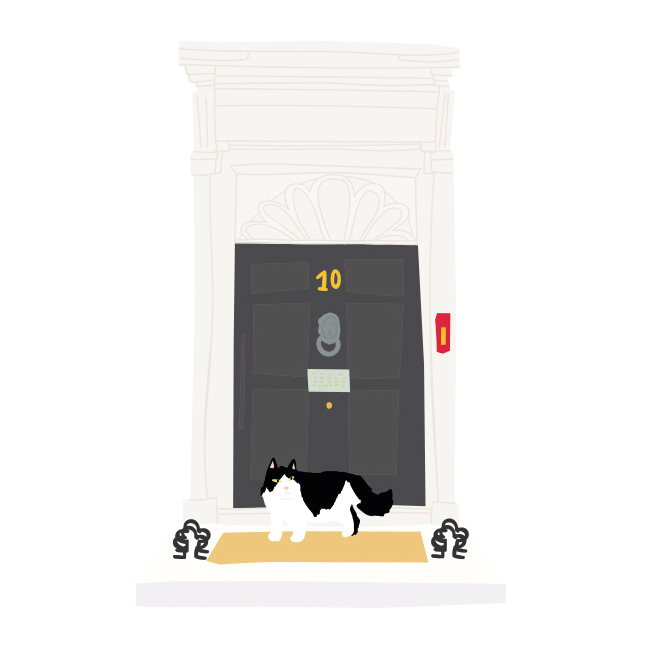
Having endured two conservative premierships, Chief Mouser Humphrey met his match in Cherie Blair. The barrister attempted to get Humphrey ejected from Downing Street, but this caused such outrage that a photo op had to be arranged of her holding the black-and-white cat – to make Humphrey comply, Alastair Campbell sedated him. The story gets weirder. Humphrey was finally relocated “for medical reasons”, sparking rumours of murder: MP Alan Clark commented “Humphrey is now a missing person. Unless I hear from him or he makes a public appearance, I suspect he has been shot”. This forced a second photoshoot, in a secret location, of the cat posing with that day’s newspapers. Humphrey was alive, but had apparently become a hostage.

Tama
When the Wakayama Electric Railway destaffed its Kishigawa Line stations in 2006 to cut costs, stationmasters were sought to help the struggling line. The recruit for Kishi station was Toshiko Koyama, who would bring along his tortoiseshell cat Tama to greet passengers. A year later Tama was officially hired as stationmaster, and the former stray became so popular that she added 1.1bn yen annually to the local economy. Tama ascended steadily during her eight years in charge, becoming super-stationmaster, ultra-stationmaster and eventually vice president of the rail company. In 2015 news of her death elicited nationwide mourning and 3,000 people attended the funeral. Having genuinely rescued the rural line from oblivion, Tama posthumously received one final promotion: Honourable Eternal Stationmaster.
Originally published in Oh Comely Issue Thirty-Seven. Illustrations by Jisun Lee.
- THE END OF ENDINGS / OH COMELY
I was 27 when I first learned that The Beatles is a pun. Even though I’ve known how to spell “beetle” for some time, I’d somehow never made the connection that the name evokes the Merseybeat scene from which the group initially sprang. Last month, despite having been a journalist for most of my adult life, it dawned on me that “news” is the plural of “new”, meaning that the news is a compilation of different new things that have happened. It’s possible that I am just exceedingly dim, but sometimes a piece of knowledge is so simple and self-evident that you are unable to recognise it. Such information is the nose in your field of vision: always there, unchanging, so the brain ignores it entirely. I bring this up because I’ve only recently realised that it might not be healthy to know what everyone you’ve ever met is currently doing with their lives.
The satirical American newspaper The Onion once published an article titled “Report: Everyone Starting New Exciting Stage Of Life Except You” – if, for whatever reason Mark Zuckerberg lost the rights to the name Facebook, this would be an ideal (albeit unwieldy) replacement. In an attempt to kill time while waiting for trains to arrive and kettles to boil, we have found ourselves in a sadomasochistic relationship with a gargantuan corporate entity. This entity uses the lives of people we know to make us feel bad about our own lives, and yet we cannot stop ourselves. Look at the interesting meals your former colleague has eaten. Look at the wedding of a childhood friend. Look at how many exotic countries your co-worker is visiting. Look at the house that the friend of your friend has bought. Look at your dream job being done by your university coursemate. Look at the beautiful child of your ex. It’s their birthday. They’re having cake. Social media can feel like everyone you know is at a party you’re not invited to, one you’re compelled to watch from afar. These people aren’t necessarily more content than you, but when confronted with curated glimpses of pleasure we can only reflect on our own comparative drabness: they are doing an exciting thing while we are looking at a picture, alone on the internet.

Study after study indicates that the passive consumption of online broadcasts from acquaintances increases feelings of loneliness and depression: the longer you spend visiting somewhere like Facebook or Instagram, the unhappier you become. We’re hard-wired to absorb information that is immediately available, and so we’re held captive by the stimulus around us. It isn’t just pop-up ads stealing seconds of your finite concentration and time: you hop online to quickly message a friend and before you know it you’re thumbing through the holiday snaps of someone who attended the same primary school as you, dissatisfied and obscurely glum.
The belated conclusion I came to, however, didn’t concern social media’s well-documented emotional impediments, as troubling as they can be. An equally pressing problem, I’ve found, is that we’ve inadvertently constructed a system whereby it’s possible to never lose touch with anyone ever again. Where once the default was that most people entered our lives and eventually left them again, now we have to make a deliberate decision to unfriend, unfollow or withdraw completely. Unless rigour is applied, the only people you ever conclusively disengage from are either horrible or insignificant enough to have left no impression at all. Everyone else is still there, simultaneously in our lives and not in them, their presence chiefly taking the form of random periodic reminders that they still exist. You’ve lost touch with them and yet you’re passing a spare minute by looking at photos of them attending the hen party of someone you don’t know.
At first glance, this seems like a quietly cheering innovation. So long as you don’t spend too long dwelling online, it can be heartening to see that someone who once meant something to you is doing well. If you’d been born any earlier in history you probably wouldn’t have spoken to that person from your primary school ever again, but now you get to see that they’ve become a seemingly functional adult with a job and a family and very strong opinions about car shopping. Good for them.
The mystery of what happened to people from our past isn’t more valuable than the answer, but we learn things about ourselves by moving forward, by shedding parts of our identity and taking on new elements as we go. Surely it isn’t helpful to see continual written and photographic documentation of all of the earlier strands of your life, as if they’re all still happening right now. The human condition is best served by a fading past, a vivid present and an uncertain future. There is value in drifting away from our past, in having people we know naturally fade into memory.
This isn’t about the dispiriting effect of these reminders: maybe the sight of someone you’ve been in a relationship with is acceptable on an emotional level, but how can you truly get over a person when evidence of them is presented to you by an algorithm every other time you’re waiting for public transport? How can the memory of someone from your past guide you when they still technically exist in your present? The secret to moving forward isn’t to act as if the past never happened, but it also isn’t to proceed as if it is moving along with you. For us to also become functional adults with strong opinions on car shopping then we need to keep the past exactly where it can play the most meaningful role: behind us.
Originally published in Oh Comely Issue Thirty-Seven. Illustration by Ana Godis.
- HOW TO GET KICKED OUT OF A MUSEUM / OH COMELY
My lack of a criminal past owes more to cowardice than an abundance of virtue. I’ve always been uncomfortable with the prospect of rebellion, which made me an unlikely candidate for the task of getting expelled from the British Museum. The plan was hatched to explore unpalatable forms of touch, namely by nuzzling different artefacts until I unleashed an ancient curse/angered someone wearing a lanyard. For my quarry, I selected possibly the most famous space of any museum in the world: Room 4 (Egyptian Sculpture). If I was going to embark on a life of crime, this seemed like a fine place to start. What follows are my notes, scribbled as I dodged tourists and the wrath of Imhotep.

Rosetta Stone (196 BC)
For those with only an hour to spare, the British Museum provides a guide of nine objects all visitors should see. The Rosetta Stone is listed first. Their crowning glory makes an obvious target for devilry, but a knock on the thick glass confirms I’m getting nowhere near it.
Obstacles: Constant crowd, glass case, monumental historical value.
Difficulty level: 9/10
Sarcophagus of Merymose (1380 BC)
Devoid of any advanced “glass” security, the Sarcophagus of Merymose sits in the open, its only hurdle being the Please do not touch sign. As I scope out the joint, a tourist is photographed pretending to lick Merymose’s head. I conclude that touching the sarcophagus will make me literally no different from this buffoon.
Obstacles: Reproachful sign, idiots.
Difficulty level: 6/10
“The Younger Memnon” (1270 BC)
The noble, haunting face of Ramesses II is one of my most-loved pieces in the museum, but rests atop a plinth taller than me. While I could theoretically use the neighbouring “Statue of Roy” to aid my ascension, Roy presumably wouldn’t be pleased.
Obstacles: Personal attachment, statue placed out of reach like a biscuit tin, Roy.
Difficulty level: 8/10
Stela of Ptolemy IX & Cleopatra III (115 BC)
The stela looks like a towering granite fishfinger and stands on a marble block standing on three random bits of wood, as if someone has been playing Jenga with inappropriate pieces. Surely a hearty thwack to the correct spot would topple it – with a lucky aim, I could definitely smush the sarcophagus lid of Padihorhepui, maybe even King Psamtek I’s screen slab. As I wonder whether I can file my copy from jail (do prisons have good wi-fi?), I read the accompanying text. The stela was originally larger but two thirds of it were reused as building materials. It’s suffered enough.
Obstacles: Ancient instance of recycling functioning as contemporary guilt trip.
Difficulty level: 7/10
Colossal scarab (399 BC – 300 BC)
It certainly is a very large scarab. “This is one of the largest representations of scarab beetles to survive”, the caption agrees. Another eye-level piece, the statue depicts the god Khepri as a dung beetle, because sure, why not, and boasts a nearby guard. The conditions are perfect – with his fluorescent tabard the guard means business – so why can’t I strike?
In my research it became clear that touching things in museums, even in the name of dubious scientific research, is foolhardy. Aside from the perils of handling old, fragile materials, when we touch objects our fingertips leave a residue of dirt, sweat, dead skin cells, and sebaceous oils that devastate over time. The British Museum receives seven million visitors’ worth of dead skin yearly.
Infractions here are common but people pet the scarab like it’s an animal. They can’t help themselves. They see something amazing and reach out to touch it. I am reminded of my 8th birthday party when my mother spent hours making an elaborate swimming pool cake. The two-tone gelatine representation of water was so realistic that my friend Oliver felt compelled to poke it, prompting my exhausted mum to instinctively whomp the poor child on the head. Confronted with an ancient statue of an ancient god we are all transformed into children excitedly defiling a swimming pool-themed birthday cake. The action is understandable – we naturally use touch to gather information – but it’s worth at least a whomp.
I retreat to a bench to watch the scarab. It looks beautiful, and I reflect that it has looked beautiful for over two thousand years. It looked beautiful in the temple of Atum in Heliopolis, it looked beautiful in Alexandria, it looked beautiful in Constantinople, and now it looks beautiful in Holborn on a damp Wednesday. If it’s cared for properly it has another few thousand years left in it. Long, long after you and I have disappeared, this absurd, miraculous scarab will be sitting in a museum somewhere, and it will still confound the heart. This is my favourite place in London, perhaps. I hope no-one kicks me out.
Obstacles: Change of mind.
Difficulty level: 10/10
Originally published in Oh Comely Issue Thirty-Seven. Illustration by Jia Dong Lin.
- JOSIE LONG / OH COMELY
On certain days it’s possible to wake up in a country you don’t quite recognise. From bruising austerity cuts to the spread of nationalism, it hasn’t been the easiest decade to believe in a fairer, more compassionate society. It’s one thing to lose a fight, and another to lose it over and over again. In search of some practical idealism, we spoke to Josie Long – comedian and co-founder of the charity Arts Emergency – about the positive steps that someone can take if current events have left them dispirited.

When you formed Arts Emergency you wrote a manifesto, and its final point said “Optimism is a weapon”. Why do you think optimism is essential?
The notion of not being cynical and resigned doesn’t feel like a mainstream concept. The whole nature of our press and even the national character is “just put up with it”. Much of the discourse in the country and a lot of what it means to be British is to deny yourself the idea that there might be something better out there and that there might be a chance to have a more humane society. Optimism is essential but I also don’t think it’s been an entirely depressing time. I’ve met so many people and been able to join in with things that have given me hope and consolation. If you look at activist organisations that have formed in the last seven years like UK Uncut and Sisters Uncut, they’ve managed to get issues such as inequality and tax evasion onto the news agenda. I’m inspired by people who are managing to effect change on a local level.
How do you think we got to this point?
What’s happened since Thatcher is the erosion of civil society, the erosion of ways that people can feel rooted in their community and useful as participating citizens in the longer term. That’s exacerbated by the housing crisis where young people have to move and move and move, and by pay going down in real terms so people are working harder but have less money. People are desperate and frustrated but they’re also disconnected from one another, and they feel let down by those who represent them. To contest this, I would say the best thing to do is to contribute regularly as part of something, no matter how small or seemingly disconnected from politics. I’m literally talking about joining a local group that helps young people learn how to garden. Anything where you’re engaging with people in a sphere that’s not inherently capitalist is useful to building a society that has different values.
If people are interested in such actions, what should be their first step?
You don’t need to set up your own organisation. A small amount of googling will find something to get involved with that you don’t even need to do the work of starting. It’s hard because services are being cut to the bone, but if you do have any ideas about what might be useful and there aren’t local groups already doing them it might be worth attempting to set them up. If you do have any sort of passions or a desire to work with younger or older people, now is the time to try.
I’d imagine it’s also a way to learn that there are those who share your values?
If you’re looking for enemies you’ll find them and if you’re looking for a fight you’ll find it, but by that same reasoning if you look for friends you’ll find them always. There are wonderful organisations everywhere if you scratch the surface, and the people in them will inspire you and make you feel like you can carry on. There’s a case to be made for caring for each other on a broader level. It’s not enough to say you’ll just look after your family and friends. We all have a responsibility to act as citizens and participate in whatever way we can. There’s a beautiful idea that you should live like you’re already in the early days of a better society.
What advice would you give someone who feels particularly demoralised?
The first thing I’d say is read Hope in the Dark by Rebecca Solnit, which is a really useful book. She says you must “make yourself one small republic of unconquered spirit”. Remember that you’re allowed to hold values that are different to your government and you’re not wrong and you’re not insane and you’re not in any way treacherous for wanting to have a kinder society that has values other than extreme capitalism. It’s important, just like with self-care and mental health, to repeat your values to yourself as a positive mantra. Don’t be unrealistic about the composition of the United Kingdom or what politics might mean at the moment. It’s wrong to expect socialism to suddenly romp home to victory when money and power are entrenched, but even though the Conservatives control something like 90% of the British media doesn’t mean that 90% of Britain holds far right views, it just means currently that’s the fight to be won. If regressive beliefs are dominant, that doesn’t mean there will never be room in this country for a social democracy. Things are difficult but you’re not going anywhere. You learn from loss and you try your hardest to regroup. You just have to keep going, because what else are you going to do?

Originally published in Oh Comely Issue Thirty-Seven. Portrait by Ellie Smith.
- SEEING THINGS IN THE DARK / OH COMELY
I am staring up at where the ceiling should be, except the ceiling isn’t there any more. In its place is blackness, and so I stare up at the blackness, at the abyss above my head. Sleep is no longer an acquaintance of mine. Like my old school friends, my former colleagues, my ex-housemates and almost everyone I’ve ever kissed, I have lost touch with sleep. Sleep feels like love: it would be nice, but it’s something that happens to other people now. I turn my pillow over as if that will do something to help.
My thoughts wander in the dark. There’s this thing in my mother’s head that she told me about once, and I thought she was teasing me until I looked it up and sure enough, it happens to other people as well. The thing she has is that she hears music that isn’t there. The synapses in her head fire as if she is listening to a song, but without any actual music to work from her brain just makes up the noises as it goes. A couple of years ago I realised that a version of this was happening to me too. When I am particularly tired I hear voices in my head, in all sorts of accents, saying things that people might say. These phantom sentences have nothing to do with each other, I haven’t heard them spoken aloud before, and they are not interesting, but they rattle on anyway. They start again now, and I pay them little notice.
I stare up at where the ceiling used to be and try to make sense of the darkness. There is not enough light for my eyes to adjust to much of anything. My curtains have been left slightly open, I suspect, as a faint orange crack on the mirror grows in detail. Logically I’m aware that it isn’t night everywhere in the world, or even that everyone nearby is asleep, but it doesn’t feel that way. At this hour it’s just me and the foxes.
Also: the radiator is making a new sound. I don’t know what that’s all about.
**

There is a place where each of us have lingered but that we rarely discuss. Human life is divided into three discrete sections: being awake, being asleep, and the bit which is both and neither. The latter is where I am writing from. At this exact moment – technically 02:37, but if you told me it was 03:37 or 04:37 I’d also believe you – I am lying in bed, my eyes squinting against the cold glow of my electronic tablet. It is now the only light in the room. The world reduces itself, at this time of night, to individual parts: the sensation of my right foot pushing against my left, the outline of my bookcase, the stray creaks from the radiator, the silence in the other rooms.
I used to live here, in this place. As a child I suffered from chronic low-level insomnia. Eventually I’d fall asleep, but it would take hours upon hours as I became progressively more afraid that I’d never sleep again. I felt guilty, like I was going to fail at school the next day, like school was already happening at that moment and I wasn’t there. The obstacle was that I was unable to switch my brain off. My body had not learned to slow its cognitive functions in the way it’s supposed to when you remove all stimulus and lie down on a comfortable bed in a darkened room. If anything it felt as if those functions were speeding up, thrown into sharp relief against the quiet gloom. Without anything meaningful to fill the gap, I would think about my inability to stop thinking, agonising endlessly as sleep revealed itself to be an impossible concept someone had made up in order to torment me.
This, like other childhood terrors, was a significant problem until the day it left and I virtually forgot about it. I’d still visit that place where everything is still except your mind, but I was only passing through. There was no profit to be had in loitering, surely.
**
The radiator has stopped making any noise at all, which is probably some kind of sign about the lateness of the hour. I’m trying not to look at the little clock at the top of my screen. It would not be a helpful activity. Anyway. As it’s just you and me, here’s something that I’ve never told anyone before.
Since I was a teenager I’ve maintained a ritual to fall asleep. What I’ll do is curl up into a ball and pull the duvet over every inch of my body, so that no light can enter and no part of me is exposed. Then I will imagine to myself that I am the participant in an urgent, highly-advanced scientific experiment. Perhaps even the fate of all life depends on its outcome, but this isn’t always clear. While dozens of shirted men and women scribble on clipboard nervously and jab pencils in the direction of a bank of monitors, my bed sits in the middle of a cavernous underground complex that a Bond villain probably hires out on the weekends. Every single person across the world is watching on their televisions, a global held breath, as machines clank away and numbers are counted down towards zero. My bed rises towards the ceiling and in that final moment, something impossible happens: everything outside of the duvet vanishes.
The universe has gone. Not only that, but it has never existed at all. I scrunch up my toes as I experience the entirety of time and space. This turns out to be a comfort beyond most others. Nothing bad has ever happened. Nothing is complicated or difficult. No-one has ever had an unkind thought about me, or fallen out of love with me, or been annoyed by or disappointed in me. From this position of cosmic solitude I’m aware that I’ll be able to bring the universe back later, and the world will be better for what’s happened, but until then there is just me, and beyond that, the void.
It doesn’t take much effort to understand what I find soothing about this scenario. It’s a fantasy I tell myself in which any worries I might have are erased from my life, and I am somehow feted for this. It isn’t just the nullification of the universe that provides solace: sometimes I imagine I’m on a raft floating down a river through black countryside at night, the only light coming from the pinpricks of stars overhead. I don’t believe the condition is unique to me; it isn’t the result of distress about my circumstances but instead comes from commonplace anxiety of the kind that naturally accumulates through the day. As we lie in our beds, we all attempt to shed our daily concerns so that we’re free to get a restful night’s sleep. Why else would we sleep alone or just with a loved one, covered up in the most private space in our home? Why else would we switch the lights off? We create a situation where the world disappears for a little while – I just happen to visualise the process. If my brain is going to trample ahead unimpeded, I may as well get something out of it.
**
“Resist the temptation to stay up all night writing before watching the sun rise with a cigarette”, our lecturer Ian warned us, “it’s not romantic and your work won’t be any good.” He was attempting to stop us delaying our essays until the final minute and esteeming bleary relief over the benefit of patiently constructed work. Unsurprisingly, it didn’t work. In the fevered stretch before any deadline, the library would transform into an impromptu class party: even if you had finished your work, you would be tempted to visit just to be where the (critical film theory) action was.
In contrast to my peers, I mostly followed Ian’s advice, give or take a night where I’d spent 17p on two litres of own brand cola and go to town on Laura Mulvey’s Visual Pleasure and Narrative Cinema. This wouldn’t last. Much like my student loan debt, I brought writing deadlines along with me when I graduated from university. As my professional life grew around delivering quantities of words by specific, always impending dates, all-nighters became a part of my emergency writing kit, a toothbrush stashed in the side compartment of a rucksack. While I’m sure my lecturer was right that 19-year-old students shouldn’t procrastinate until the night before their deadlines (although they always will), there is value in working when the rhythms of life have slowed.
In his non-fiction book On Writing, Stephen King states that you should write “with the door closed”, a goal that’s increasingly difficult when the terrifying world news doesn’t end and a device hums softly in your pocket every few minutes. What I’ve found in these long late-night sessions is not the agitation of my youthful bedroom or the mad panic of the study hall, but a strange sort of calm. At night, the phone is in no danger of ringing. I’ve said farewell to my housemate. Everyone I know on twitter has gone to bed, and if I wait long enough, all of the Americans will go to bed too. E-mails stop arriving in my inbox, even the press releases and the spam. The distractions and the excuses fall away in equal measure.
This is not a new discovery. I’ve accidentally stolen a book from a former colleague on the daily rituals of the famous dead, and many of them were similarly drawn to the small hours. Marcel Proust wrote exclusively in bed while lying horizontally, his head propped up by pillows (Proust also lived off of two cups of coffee and one or two croissants every day, and that certainly will not do for me.) But as someone who spent their childhood trembling at the notion of a place which isn’t asleep or awake, it’s a revelation to find myself welcome here. As the world reduces itself to individual parts, eventually there’s just me and a blank screen, with seemingly all the time I need to fill it. The universe has gone, and I’m ready to begin.
Originally published in Oh Comely Issue Thirty-Six. Photograph by Laura Ward.
- SIX UNLIKELY UPRISINGS / OH COMELY
It’s possible to wake up one day and completely change the world. Yes! We have it within us to see something amiss in society and to find a way to set things right. It’s why tyrants eventually fall and justice ultimately prevails: as a people we possess the capacity for action, for solidarity, for transformation. For every hard-fought strike, advance in civil rights or inspiring act of progressive defiance, however, there are those other occasions when it might have been wiser to not bother at all.

Paying Weezer to quit
When it comes to our favourite groups, the best always seems to be behind us: the strange new album with its strange new songs can’t possibly compare to the one we’ve lived with for years. Indie band Weezer have suffered from a notably acute version of this phenomenon, consistently upsetting fans since around 1996. 14 years on from that early apogee, Seattle-based grouch James Burns attempted to raise $10 million to convince them to call it quits, writing in his online proposal: “I beg you, Weezer. Take our money and disappear”. The band said they’d do it for $20 million, but regrettably for James the campaign only raised a few hundred dollars. Weezer are currently working on their disappointing 11th album.

Overthrowing George II
It isn’t easy to rebel against your own government. Historically most insurrections end in bloodshed and failure, and even if you do evict your ruler there’s a reasonable chance you’ll end up as much of a despot as they were. If you’re planning sedition, then, you’d better have good reasons. Charles Edward Stuart did not. In 1745 “Bonnie Prince Charlie” challenged George II’s throne believing that it belonged to his family, but failed after making tactical errors during the Battle of Culloden. A century later Jacobitism experienced a romantic revival, but essentially it was one aristocrat trying to replace another. Defeated, Charlie fled Britain disguised as a maid called Betty Burke. People were apparently easier to fool in the 1700s.

Electing a monkey
Hartlepool has a weird thing about monkeys. During the Napoleonic Wars – so goes the exquisitely bizarre, almost certainly apocryphal story – a French warship sank off the town’s coast, with its only survivor being a monkey dressed in full military uniform. Assumed to be a Frenchman, the simian was duly tried in court and hung as a spy. In tribute to this historic injustice, Hartlepool F.C. decided to make their mascot “H’Angus the monkey”. H’Angus fared better than his inspiration by being elected as mayor of the town on a platform of free bananas for schoolchildren. Stuart Drummond, the man inside the monkey, swiftly ditched the costume and served three terms despite failing to deliver on his banana pledge.

Constructing a Death Star
It’s extraordinary what people can accomplish when they get together. Please note that the word “extraordinary” does not necessarily mean good, or even halfway-sensible. In a valiant, misguided attempt to give its citizens a voice on important issues, the U.S. government launched a platform in 2011 for creating online petitions: if one garnered over 25,000 signatures it would receive a White House response. Inevitably, silliness ensued, as 34,400 people signed a petition asking for a Death Star to be built in the interests of national security. A government official – it’s possible they weren’t treating the matter with utmost seriousness – politely refused, explaining that it’d cost around $850 quadrillion and also “the Administration does not support blowing up planets”.

Repealing New Coke
Emotional attachment to grocery items runs deep, as anyone who is still calling them them Opal Fruits (19 years later) will tell you. A prime example: in 1985 consumers responded furiously when Coca-Cola’s formula was updated in order to keep up with sweeter rival Pepsi. Even though taste tests suggested a preference for the new version, executives hadn’t counted on the power of lifetime habits. The endeavour was considered one of the biggest marketing disasters of all time, and 77 days after the launch “Coca-Cola Classic” was deployed to soothe nostalgic customers, eventually displacing New Coke altogether. In a delicious twist, ingredient changes had been rolled out over the previous few years, so it wasn’t quite the same drink as before anyway.

Voting yourself out of existence
Many things that can arouse an existential crisis: a depressing tax return, reaching a particular age, an old classmate’s facebook post, 20 minutes in Primark. Unless you once lived in Castlewood, Virginia, though, it’s rare for dark nights of the soul to be caused by a ballot initiative. Faced with heavy taxes after the population dropped from 20,000 to 9,000 over a decade, council members proposed a de-chartering measure that would see the town absorbed by the larger Russell County. “There are more cows than people around these parts” said a councilman, presumably before sighing heavily. 749 residents voted for, 622 against, and Castlewood officially ceased to exist. At last count its population was 2,045. The message is clear: referendums are terrible.
Originally published in Oh Comely Issue Thirty-Six. Illustrations by Jessica Wheeler.
- PEARL MACKIE / OH COMELY
The programme was called Mean Town. Pearl Mackie hadn’t heard of it before, but had been asked by her agent if she might be available. Since leaving drama school five years earlier she’d mostly performed at fringe theatres, but a lengthy spell in the West End production of The Curious Incident of the Dog in the Night-Time suggested that she was ready to move on to the next stage in her career. Mean Time, she would soon learn, was an anagram of “Woman Ten”, which was itself a codename for Bill Potts, the name of the eponymous Time Lord’s next companion in the tenth series of Doctor Who.
Pearl was to become well-acquainted with elaborate acts of subterfuge; few television programmes invite as much speculation as Doctor Who, a genuine national institution over fifty years into its run. Suddenly the word “unknown” was being attached to every description of her in the press, and she was sequestered in Cardiff for ten months to film the series. When we meet she is only weeks from the end of her marathon shoot, exhausted but palpably excited. “I just can’t wait for people to meet Bill,” she says, meaning it, “She’s the kind of person I’d want to be friends with. I think she’s awesome, but I’m probably biased because she’s me.”

More than most programmes, people are hungry to find out what’s going on in Doctor Who. What’s it like to work on something for almost a year under intense scrutiny?
Everyone wants to know about it. Friends keep asking me what’s happening, begging me to send them pictures. It can be difficult when you come home from work and you’ve had an amazing day, filming something really cool, and you want to tell someone but you can’t. I’ve gotten very good at discussing the show in non-specific terms, so I can explain without giving anything away. I just hate spoilers. My cousin used to tell me the ends of movies all the time. Five minutes into the film she’d say, “Oh I’ve seen this, he dies”. I’ve just started watching it! Now what do I do – should I carry on watching, knowing that this poor man is going to die? It ruins the experience.
How far in advance did you learn what would be happening?
We get the scripts episode by episode, which has actually been great. It’s something I’ve never experienced before: when you’re in a play you know the whole story from beginning to end, but one of the best things about this job is that I don’t know what’s going to happen next. As a real person I don’t know what’s going to happen to me tomorrow, so it’s interesting to have the same thing with a character, to gradually build on her over time. Very occasionally though there’s something you read and you think, ah, I didn’t know about that, if I had I would have put it in earlier!
Did you feel any pressure about joining such a well-established show?
I’d watched a few episodes, bits and bobs, but Doctor Who was never a massive part of my life. I’m 29 so I didn’t grow up with it. The show came back when I was about 16, and pretty much the only thing I watched back then was The O.C., in bed on Sundays. When I got the job I said, “okay, give me the back catalogue, let me watch it all”, but they told me no. Bill doesn’t know anything about that world, so they liked the idea that I was discovering it all at the same time as her. Also, it’s hard as an actor to watch a brilliant performance and not subconsciously take a little bit from it. If I watched any of the previous companions, who are all fantastic actresses, I’d struggle to not emulate some parts of their performances within my own, especially as they’d be in similar situations. I thought maybe it’s best not to do that for now, and when I’m finished I can binge-watch the whole thing.
You’re from South London, so is it helpful to film away from home?
It really is. I’m mainly able to head back at weekends but I do get homesick sometimes. It’s useful though because during the week I can put my head down and work hard, which I need because I have to be up at twenty past five every morning. At night I get in and have a bath, eat dinner, learn my lines and go to bed, so it’s handy to not be distracted by my mates wanting to go out for food, or they’re doing something and want me to join them. Even swinging by for an hour would be scary. “I’ve got to get back, it’s past my bedtime!” I’ve become Cinderella.
Was it an adjustment to act in an effects-heavy TV programme after mostly working on stage?
There’s a myth that you have to act smaller for camera. You can be quieter as you don’t have to project to the back of the auditorium, but there’s definitely room for subtlety on stage and broad emotional work on screen. The way my performance has changed regarding the technical aspects is that I didn’t really know what I was doing before! Peter Capaldi has been very helpful with that. He’s so experienced, it’s fascinating seeing the difference in his work: his performance looks great in real life but then you see it on screen and it’s phenomenal. I’ve learned to use camera angles – how to hit marks and tailor my acting to the frame they’re using. If it’s a close-up then you don’t want to do stuff that’s too big because it’s distracting. By the end of the first block, six weeks in, I’d probably done more consecutive hours of filming than lots of my friends who’ve been doing television episodes for years. I feel like I’ve learned my craft in front of the camera. But I haven’t seen it yet, so don’t take my word for it.
Originally published in Oh Comely Issue Thirty-Six. Portrait by Liz Seabrook.
- INFREQUENTLY ASKED QUESTIONS #5: PINING FOR THE FJORDS / OH COMELY
You die on a Tuesday, which surprises you for several reasons. Over the years before that fateful weekday you had generally avoided contemplating the circumstances which might prompt your untimely demise, but even if you had given it some thought, you certainly wouldn’t have anticipated that your death would come from tripping into the road after failing to tie your shoelaces. This was, after all, something that your mother had explicitly warned you about. In retrospect you’re lucky to have made it this far without dying elaborately as a result of not tidying your bedroom.
Before the enormity of the change sinks in, you find that you are slightly excited to be dead. It had not been in your plans for the week. Logically you understood that it would happen eventually, but in a small, unconquerable bit of your heart you always secretly believed that you would never actually die. Now that you have perished, it is like you’ve prematurely seen the final episode of a television programme that everyone is obsessed with. It was neither as painful nor as scary as you might have feared. It was not even the worst thing to ever happen to you. You have definitely had breakups worse than your own death.
You leave your body in the street and continue on with your day. It does not take long to adapt to the new reality of your existence. The closest you come to sadness is a passing concern that you should be feeling more sad than you are. Your death was just another part of your life, you understand now. What is unexpected however is that you are given no guidance about what to do next. This is much the same as during life, you suppose, but you had been conditioned to expect at least a brief consultation with some manner of celestial administrator. Even in death, you are still essentially on your own, and while this doesn’t upset you, it does leave you with a lot of time on your hands. It is probably not worth going to work any more, and your social calendar has emptied dramatically.
The sudden lack of a corporeal form is difficult. You spend a fruitless afternoon in a local library trying to read over people’s shoulders, but they are either too slow or too quick for you, and you soon lose patience. Cinemas and museums are better, and you discover that you now possess a level of attention that was previously absent when there was a million things to worry about. You rarely visit figures from your life: it is hard to see them upset, and almost as hard to see them happy. As fatigue has ceased being an issue, you cultivate an interest in hiking. Perhaps it might be fun to walk to another country, you think, although if you didn’t like the area then the return journey would take ages. You’re not sure if this is going to be it, forever, or if this is just a stage like the ones that came before, but you do know that you should probably come up with a plan. On balance, you mostly wasted your life; you do not want to waste your death as well.
What do you do next?
