- ALICE BIRCH / OH COMELYSometimes if you want something to exist you have to make it yourself. In the midst of a busy, burgeoning theatrical career, playwright Alice Birch put this saying into practice by writing her first screenplay, Lady Macbeth. Adapted from Nikolai Leskov’s 1865 novel Lady Macbeth of the Mtsensk District, with the story transplanted from Russia to 19th century Northumberland, it is a disturbing study of Katherine (Florence Pugh), a teenager sold into marriage to a cold, cruel and impotent middle-aged industrialist. After Katherine throws herself fervently into an affair, her actions turn murderous as the household is engulfed by violent events. Although a viewer can sympathise with Katherine’s circumstances, she’s capable of abhorrent behaviour and is frequently callous to those who are similarly disadvantaged. The appeal of such a difficult figure, Alice explains, was simple: “I hadn’t seen a woman like that on the screen before.” While representation is hugely important, it is not enough to have more female protagonists if they are just saintly props. Through all of her work, Alice revels in writing complicated women. “I think that’s the most interesting part of my job”, she says, “finding people who are difficult to love and making myself fall in love with them, and then trying to recreate that experience for an audience.” This is evident with Katherine, a compelling, contradictory woman who resists simplistic interpretations. “She’s ruthless and manipulative but she’s also incredibly young and has been through appalling things, living in a claustrophobic, patriarchal environment. It’s tough for anyone to break out of that”. Despite this nuanced comprehension of the character, Alice doesn’t come to the easy conclusion that Katherine becomes an oppressor as a result of being a victim: “You can absolutely understand the things she does, but that gets harder as you progress through the film. I talked a lot with the director Will Oldroyd about how violence breeds violence, yet a different woman wouldn’t behave in the same way.” It’s here that Alice departs from her source material. One of the benefits of adapting a 151-year-old book is that you have a bit of room to manoeuvre: the author – fingers crossed – is long dead, and the world portrayed is sufficiently different from our own that few will mind if liberties are taken. Indeed, there’s an implicit understanding that the screenwriter will use the shift in context as a way of commenting both upon the book itself and the times we inhabit. While Alice takes advantage of this latitude, changing the novel’s final act entirely, she believes the key difference is the depiction of Katherine. “Although the book is about poverty and a certain class system in Russia that didn’t feel far from what we were concerned with, I’d say I was more interested in gender than Leskov was”, she says. “Katherine’s a remarkable character in the original text, but I don’t know that he’s writing her with much empathy. She’s straightforwardly nasty and he’s pretty cold about her from the off. That felt like the biggest challenge.”

With an increased emphasis on the lived experience of its characters, Lady Macbeth nods towards the complicated history of fictional women, whose desire for some manner of freedom expresses itself as a violent or sexual challenge to the established order. “It’s a character trait we’re familiar with in literature of that period”, she reflects, “these kinds of wants and needs and passions lie dormant for years and then are suddenly triggered, opened wide.” While she’s a fan of period dramas, she admits that she often finds such elements absent in more sanitised productions. “Some period films feel quite distant to me. You put a lot of crinoline on women and suddenly they’re talking in a way I don’t recognise. We consciously tried to avoid that as much as possible, to create characters who still felt close to us now. I hate all of that politeness. It doesn’t feel realistic. Those domestic structures were a different kind of violence.”
The story of a woman responding brutally to societal restrictions had stayed with Alice since she picked the book up at university, but she was also drawn to the challenges of a different medium. “I’m very happy writing plays – I could write them forever – but I was excited by the idea of testing new muscles”, she says. Happily, she describes the experience as being a uniformly positive one, but is frank about the difficulties of being a writer: “There’s no way to say this without sounding like a massive idiot, but it’s all quite painful. I don’t have an easy relationship with writing. I don’t enjoy it.” She maintains, however, that this fraught process is crucial to creating meaningful work. “I don’t trust it when it comes out quickly. Maybe this is just what I tell myself to justify all the angst, but I believe that when you look at someone’s work, whether that’s a play or or a piece of art, anything, you can feel what it has cost its maker in some way.”
Without even factoring in the complications that arise from concurrently raising a two-year-old son (“It’s really important to talk about because it’s so much harder than people think it is”), it is refreshing to hear Alice – one of the most talented young playwrights working today – talk openly about the fundamental struggle of her job. Like a character in her work, a creative profession is not straightforward. It can be both a labour and a joy, and this is okay. Alice, undaunted, is inspired by the prospect of new tests. “I feel a bit like I want to do everything. I’m up for all of it.”
Originally published in Oh Comely Issue Thirty-Six. Portrait by Lauren Maccabee.
- ALICE LOWE / OH COMELY
After several years as a comic actress and writer, Alice Lowe was ready to take the next step and direct a film. The process, however, was a long one. “When you’re trying to get your first film funded, the difficult thing is you might be a complete idiot and they just don’t know,” she says. “I knew I wasn’t a complete idiot, but I needed a way to show it.”
Alice then became pregnant for the first time. This didn’t slow her down: six months into her pregnancy, she had an idea for a film about a woman taking murderous revenge on seemingly unrelated people. “It wasn’t my plan to make my directorial debut while pregnant,” she recalls, “but it was too good of an opportunity to pass up”. Two months later she had written and shot Prevenge, which is as dark, weird and funny as you’d hope for from the co-writer of Sightseers. “I had a very powerful deadline!” she says. “It was weird to do it all so quickly, but that helped me express the story clearly instead of overcomplicating everything. I didn’t have time to think too much.” We spoke to Alice about making the film.

Does Prevenge reflect how you were feeling when you were pregnant? There are references to pregnancy being a hostile takeover or a human sacrifice.
I had a lot of fears about pregnancy which I put into the script, but I think it exorcised them. People have asked I had a horrible pregnancy because it’s very nihilistic in some ways, but I had a brilliant pregnancy: I was making a film! I was having loads of fun. At the same time, when I became pregnant I was worried. Am I ever going to direct? Am I going to get any more work, or will I fall out of acting because people assume that you’ve died when you have a baby? All of that stuff went in. Also it was about being an outsider, because I felt that when you’re a freelancer and an artist of whatever type, you have your own rules. You don’t work by the same routines that others do, and so when you have a baby you’re locked into those routines. I don’t even have a boss and suddenly a midwife is telling me I can’t do this, I can’t do that. There’s the peculiarity of being with a bunch of women in a prenatal yoga class that you feel you have nothing in common with, but you’re supposed to feel affiliation with them because you’re all pregnant.
Society expects pregnant women to be a certain way, but your character Ruth spurns this notion at every turn. What was your thinking behind that choice?
I wanted to create the opposite of a stereotypical pregnant women. It’s not based on a psychological reality. It was metaphorical: this character who comes along and slashes through that stereotype. It’s about freedom, that this woman is allowed to be who she wants to be. There’s something cathartic and satisfying about it. There are things that are tragic about Ruth and she’s damaged as a person, but also, wow, she’s pregnant and she’s getting to do whatever she wants. It’s a bit of wish fulfilment. Ruth takes on different fake identities during the film, and the first one is quite a sweet, mumsy character. Afterwards I thought that what I’ve done is write myself a character that I would normally get cast as – once you’re over 35 you’re mostly offered these boring mum characters who wear floral dresses and are very caring – and then completely exploded her. I literally burn her clothes. I was thinking a lot about how women are portrayed in films, how other people control how you’re seen. Once you actually take control yourself, you think: that’s nothing to do with me, why would I be interested in it?
I can’t actually think of a feature film written, directed by and starring a pregnant woman before.
Someone said to me recently that I was “allowed” to make the film because I was pregnant. I thought that was very interesting, the idea that it gave me permission to say what I want. If I hadn’t been pregnant there might have been people asking why would I think a pregnant woman could feel this way. I think it’s really important for women to be able to tell whatever story they want, and this inevitable moral judgement shouldn’t be an element. I shouldn’t have only been able to write this because I was pregnant, I should be able to write what I want. When you’re a female director or writer, people lay everything at your door. You’re expected to speak for all women. “Are you trying to say all pregnant women are violent?” Nobody ever says anything like this to male writers. They understand it’s an individual character who is making individual choices.
Did you give much thought to how we should perceive her, about how sympathetic we should be towards her killings?
It was an experiment in reaction to being an actress: I’m always asked if a female character is “likeable” enough. Isn’t it interesting that we worry about that with female characters and judge them more? My theory is that if you put a likeable enough performer in a role – myself, haha! – you can sell anything to anyone. It doesn’t matter what they’re doing, you’re going to go along with them. I deliberately wanted to make Ruth an unremitting, cold character that you maybe come to like and empathise with. I know it’s not the traditional revenge structure, where 15 minutes in you know exactly why the person is doing what they’re doing and it enables you to have empathy with them: you see that Liam Neeson’s daughter has been kidnapped so you can enjoy the horrific violence he perpetrates on everyone around him. I didn’t want to do that. I wanted to say: so what? Why should you care what this woman’s doing? She’s doing it anyway.
What do you think is driving Ruth, then? Is it grief? Fear? Prepartum depression?
I wanted the audience to wonder whether she’d always been like this. One of the things I was trying to investigate was whether people are really changed by pregnancy. That’s the fear you have when you’re going to have a baby, that you’re going to come out some Stepford Wife at the end of it, saying “I love babies and I only talk about babies now and my previous identity has been erased!” Just because you’re a mother it doesn’t mean that your instincts or your personality completely change. I’m still me.
Originally published in Oh Comely Issue Thirty-Five. Photograph by Toby Coulson.
- MAREN ADE / OH COMELY
Toni Erdmann doesn’t quite exist. Maren Ade’s third feature isn’t named after either of its main characters but rather a mid-film persona adopted by Winfried (Peter Simonischek), a shambling, melancholic music teacher and inveterate jester who elbows his way into the life of daughter Ines (Sandra Hüller). By transforming himself into a stranger with joke teeth and a ridiculous wig, Winfried is able to falteringly reconnect with Ines despite bringing chaos to her personal and professional life.
“It’s only funny for us”, Maren observes, “For them it’s a nightmare. That’s why we like it.” The writer-director touches upon a range of themes in the film, from the shifting boundaries of parent-child relationships to the ethics of foreign-based management consultancy, and yet also includes a scene in which Winfried dresses up in a full-body Bulgarian ritual goat-pelt and and gatecrashes his daughter’s birthday brunch. Despite combatting jet lag, in person Maren proved as thoughtful and clear-eyed as her film.
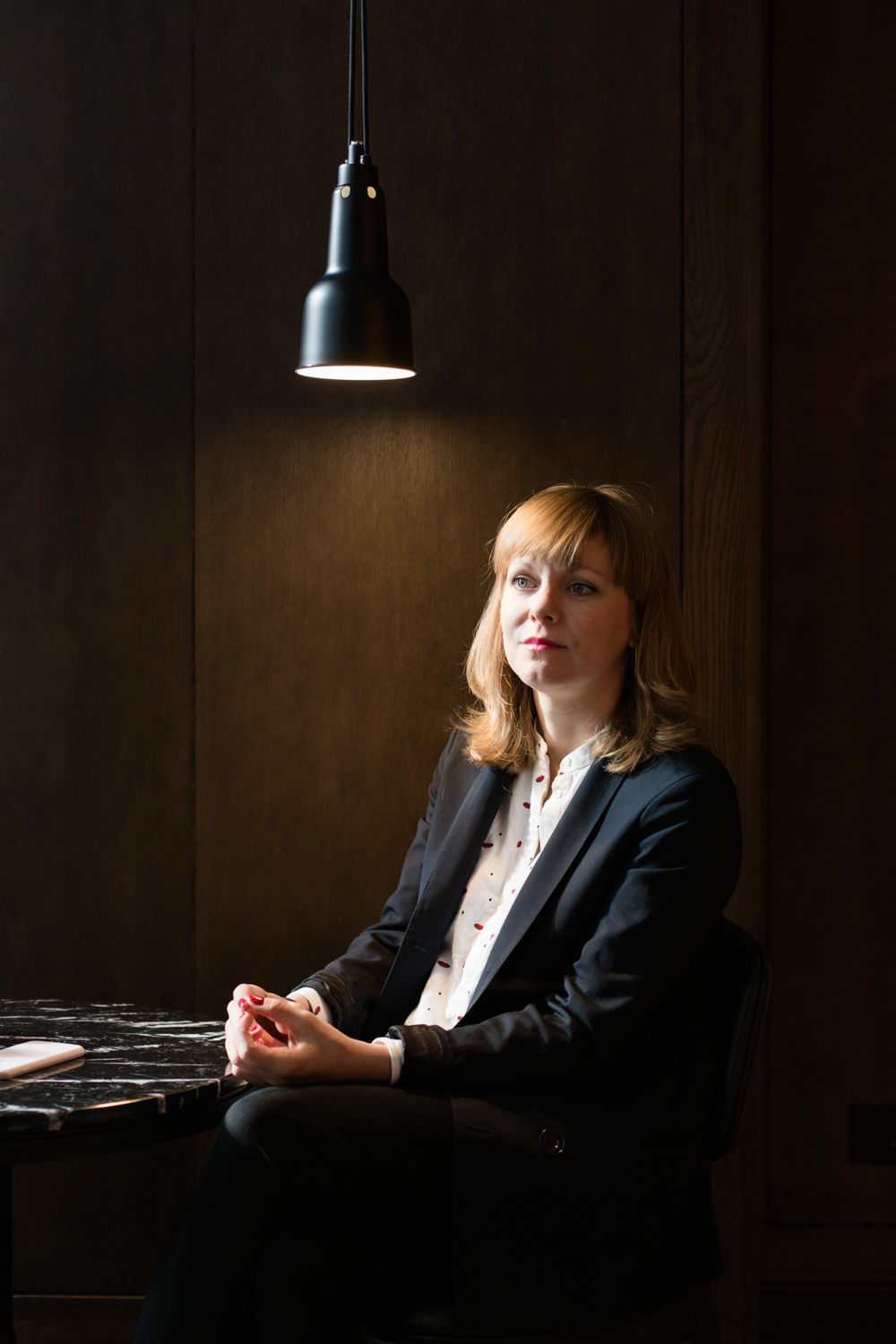
It’d be possible to make a concise version of this story that just depicts the relationship between Ines and Winfried, but the film also deals with several broader topics. What attracted you to that approach?
There was this relationship with Ines’ father but I was equally interested in her, in her job, in the business world. I come from realism and believe it’s important that each character has their own problems that maybe have nothing to do with each other. If it’s character-driven instead of plot-driven then people take actions you don’t expect, and that’s when interesting things happen. It’s right for the situation for Ines to struggle with certain emotions, even if they make the film fuzzy or don’t fit so well into the plot. I like to make little excursions with characters and follow what interests me most, so over the whole story you get a more complicated picture of a person.
You illustrate their relationship using lots of small-but-telling details, like Winfried giving Ines a cheese grater for her birthday. Why that gift?
A cheese grater is a desperate present to give to a daughter who’s an international businesswoman, but on the other hand it’s very practical. I thought it was something that showed how Winfried really knows himself. He’s aware that it’s not a good present but does it anyway. At least he bought a designer cheese grater, but you understand why it’s annoying. I wanted him to give her something from the kitchen. It’s an accident, something she doesn’t need at all.
What effect does “becoming” Toni Erdmann have on Winfried? Does it liberate him?
What’s good for him is that although he’s hiding behind the wig and the teeth, it’s possible to be more honest with her. He’s open with his critiques. As Winfried he suppresses all his suspicions about what she’s doing in her life and job and whether they’re the right things. It’s a radical approach but they come to see each other at eye level. He starts speaking an aggressive language she understands. It was important though that you could always see through to Winfried so you don’t forget about him. It’s him that’s doing Toni and it’s out of desperation, so it’s an interesting conflict.
Ines works in a male-dominated environment which the film explores indirectly: for example, she’s asked to take a client’s wife shopping, something you can’t imagine happening if she was a man. How does she fit into that world?
It’s too simple to say there’s sexism going on among her male colleagues. For me it’s more interesting to ask why is Ines participating. She’s not forced to go shopping. She could have found a way out if she really didn’t want to. It’s something that perhaps she’s too used to, and during the film that she starts realising that. Ten times it’s funny, eleven times it’s annoying. I didn’t feel it was such a big topic. It’s only present because I took a woman and put her in that situation. It was there from the beginning so I had to decide how I showed it.
Is there a moral element to how you portrayed Ines’ job, which facilitates the downsizing of other companies?
I talked to a lot of consultants before writing because I had to understand what they’re doing. The argument they’d make was that restructuring is sometimes necessary to save a company. If you change things maybe you can make the company more profitable and save other jobs, and that’s always the dead end in the discussion. How I see Ines is that she’s not a cold person, but she protects herself. It doesn’t make sense for her to think too much about people working on the oil field. Employees become a number. Her father, who judges her for this, is in the luxury position. The enemy for his post-war German generation was really clear: it was the generation before. For Ines life became too complex, too complicated. It’s difficult for her to have a clear position. She sees Winfried’s system of values as too romantic for her, a sinking island. What takes some time in the film is that I tried to get both perspectives, to always have both angles on a situation.
It’s been seven years since previous last film, Everyone Else. Was the gap helpful?
For two years I did different things, but for the other five it was only this. It’s a long film! It’s almost three hours, so it was always like making two films. Every step took more work. I was constantly working on it, but also I participated in every bit of the project so I never left the film alone. I don’t mind that it took a while, though. It’s a luxury to never be really under pressure to leave the world of film-making before you’re happy. After three films you realise that you have something like handwriting, a way you work. Although I might want to change I don’t think I will, and that’s okay.
Originally published in Oh Comely Issue Thirty-Four. Photograph by Liz Seabrook.
- BEBE CAVE / OH COMELY
“It was wonderful. It was terrifying.” Bebe Cave’s description of filming Tale of Tales could be a blanket statement for her current state of mind. As a princess who rescues herself she gives the standout performance in Matteo Garrone’s dizzying fairy tale, an impressive feat considering that her co-stars include Salma Hayek, Toby Jones and Vincent Cassel. At only 18 years of age, when we meet she finds herself at the precise moment where a childhood of occasional acting roles has become a full-blown occupation, and her excitement is indistinguishable from panic. If she seems poised for a healthy career, it is merited: Bebe’s undoubted precociousness is ultimately winning because of her evident passion for her work. Even if she is afraid, she likes to dive in head first.

You’ve been acting since you were 11. How did you get into it?
I’m the youngest of five, so all of us are competitive for the spotlight, and also I’ve got two older siblings who are actors. It was a very dramatic household! I never went to a particular drama school, I just did it alongside my studies. Now I’m out of school for the first time and life is scary because I don’t have a safety net anymore, but I’m fortunate to have known for such a long time what I want to do. A huge part of it is that it’s something hugely imaginative. I never had many friends. I had a lot of imaginary characters to interact with and I suppose I never quite let go.
Did you ever consider anything else?
I really loved school and was massive classics enthusiast. I was one of those people that’s a bit of a teacher’s pet because I was always more used to adults. I used to chat to the teachers. I was not popular as you can probably imagine. I wanted to do all these different things but it never even occurred to me that there would come a point where I’d need to decide. Last year was very stressful, choosing whether I wanted to go to university, but the decision I came to was that this is the thing I want to do more than anything else, and it’s so competitive that if you don’t give your heart to it you might be left behind. You can’t ever predict anything really, so it’s quite exciting that I don’t know what’s going to happen. As I tell my father: it’s the life I’ve chosen. University isn’t the only form of education. I can self-edify, that’s what I’m trying to convince him. He still thinks I should be a doctor.
You appeared in Great Expectations and have acted on television and the stage, but Tale of Tales is your first major film role. What was it like to work on something on a much larger scale?
The thing I loved about Tale of Tales was that it was just such a whirlwind. I had no idea what to expect and every day was a new challenge. It was a completely different way of working, because Italian cinema, or at least this is my experience of it, was that they’d take a very liberal, artistic approach to things: I wouldn’t be wearing the proper safety harness but I’d be on top of a castle.
Princess Violet goes through a very physical journey. Was it taxing?
Oh, I’ve got scars. Actual scars. There was no mucking about with prosthetic rocks. They were genuine boulders that I was being slammed into. That’s what made it so exciting and intense. The dirt was real dirt. Insects were crawling all over me. They wouldn’t let me wash my hair. That was the worst part. We filmed it in sequence so I gradually got more and more dirty and beaten-up and exhausted. By the time I’d got to the climax of the film, which has to be this strong emotional reaction to all of these things that have happened to her, it felt real.

What did you enjoy most about the experience?
I’ve never worked in a foreign country before so that was another challenge to add onto it, but everyone was so friendly and it felt like a big family. Also because I loved Latin so much at school I understood some of the Italian – it’s very similar and has roots in Latin. It became an incentive for me to be able to try to learn the language because my plan is to go back there one day and marry an Italian! I think it’s going pretty well. I did a course a couple of months ago and I’m still working on it now. I’m not anywhere in the region of being confident because they speak so fast, but as long as I listen to them talk, I’ll be in a good place. I just need to smile and nod and it’ll be fine.
You must find that your Italian veers towards the fantastical.
Exactly. I can say flea, I can say prince, I can say ogre. All of the important things you need in life.
The film is based on early Italian fairy tales. As they’re broader and wilder than contemporary dramas, was it important to find the emotional truth in your scenes?
You don’t want to play up to the archetypes of the character: the princess who’s a damsel-in-distress. With such exquisite surroundings and costumes, it could be easy to fall into the trap of making the way that you act overly magnificent. What Matteo wanted was to get all of that out of the picture and create something earthier. Even though I was tackling an ogre and there were magical old ladies and amazing transformations and dragons, what he wanted to bring out was that these are human struggles. At first Violet is looking for a dashing prince to come along, but she learns that there doesn’t have to be someone else to define her as a person. She doesn’t need a husband that is handsome and brave, she just needs herself.
Originally published in Oh Comely Issue Thirty-Three. Photograph by Liz Seabrook.

- KELLY MACDONALD (SWALLOWS AND AMAZONS) / OH COMELY
Kelly Macdonald’s talent has been evident since her fiery debut in Trainspotting, but the most striking thing about meeting her is her sense of perspective. Two decades into a diverse career that has seen roles in everything from Gosford Park to No Country for Old Men to the upcoming adaptation of classic children’s book Swallows and Amazons, Kelly is sanguine about the complexities of being a film actor. Hearteningly, she is determined to enjoy her work rather than worry about it. When she explains her lack of desire to act on stage again, I mention that some actors like the opportunity to hone a performance over months. Her good-natured shrug of a response is typical of her attitude: “Nah. That’s what I say to that. Nah.”

What was it like to go from playing a character over five years and 56 episodes in Boardwalk Empire back to playing one over the course of a single film in Swallows and Amazons?
Actually one of the joys about Mrs Walker in Swallows and Amazons was that she wasn’t Margaret Thompson. I hadn’t played anybody but her for a while and it felt so freeing. I had a bounce in my step. Not that I didn’t love the experience, but it’s nice to play people who talk and behave in a different way. I never went to drama school but Margaret was very changeable from season to season so it did feel like she evolved. I learned so much, it was like my drama school.
Have you found that not going to drama school was useful because you didn’t pick up bad habits? Do you ever think about it?
Oh, no. I used to, but I’m too old to worry about that now. I’ve done too much for it to be a concern. If you get to go to drama school that’s fantastic, and if you get to do this without going that’s also good. There’s a certain amount that you can only learn as you go along.
Over the past 20 years you’ve worked consistently in great projects. Has it ever been difficult?
There have been lots of long periods of unemployment. I suppose I could be called picky but even when I was struggling and something came up that I didn’t feel right for, I would probably not go in for it. I’ve always been just about okay so I haven’t had to do anything to pay the mortgage. I would coast for a while until the right thing came along.
Maybe that’s better in the long run, instead of having films you can’t stand behind you?
I don’t think it matters, honestly. As I get older I think: “fuck it”. If you do something which your heart isn’t into, nobody cares. And if it doesn’t work out then no-one will really see it anyway. A film is just there and gone. It’s all about the experience, not what happens after the shooting finishes. Obviously it’s nice if people go to see it and like it, but for me the enjoyment is in actually doing the work and being there on set.
When you’re choosing roles are you looking for a mix, then?
I don’t deliberately seek out anything. It’s just what appeals and what I respond to. I don’t have any rules. I’ve not done any horror films, that’s a missing thing that would be fun at some point.
Would you appear in a massive blockbuster?
I would love to, it’s just not been my area. It’d be great to have fun on something big and shiny but I’m not an ‘action’-type of person. Playing Princess Merida in Brave was probably the most like that but it was just my voice. My voice got very energetic.
What was it like to act purely with your voice?
It was definitely challenging – far more work than you’d expect. You have to do the lines over and over again, on your own. When you watch an animated film you take a lot for granted. There are so many sounds! It’s real brain work because you have to make noises, like making a noise as if you’re getting off a horse, and it’s very specific.
How do you make a noise like you’re getting off a horse?
Well exactly! You have to do it a lot, whatever it is. There are tons of sounds that as a cinema-goer you don’t even know you’re hearing, but if they weren’t there it would be a lesser experience.
Merida must be a role that stays with you – do you have to reprise it?
For games and things, yes. I took my kids to Disneyland in California and we were asked if we would like to meet the girl who plays her there. They got very coy around her. I was watching her being Merida and I thought, oh thank god I just had to do the voice, because this girl really embodied the character. She was so exuberant and chatted to all the families and was totally Merida the whole time. I couldn’t do that. Even if I’m doing an accent I don’t really do it on set until we’re filming. A lot of actors just stick with one for the entire period they’re working. That makes sense, but a part of my brain gets embarrassed, and if I’m making friends on set I’d feel I wasn’t being honest.
Are accents fun to learn?
It’s often weirdly helpful. Swallows and Amazons is about an English family who live in Portsmouth in 1935, so I was asked to do RP (Received Pronunciation). We did the read-through and afterwards Philippa Lowthorpe the director called me, saying she thought it’d be fun to make Mrs Walker Scottish instead. That was great because I could be freed up a little and I wasn’t just playing Period Mum, giving some kids a row. She could be more vibrant. But I’d hardly ever work if I could only use my own accent.
As a modern viewer the part of Swallows and Amazons I found most surprising was that your character Mrs Walker lets her children leave on an adventure for days, completely unsupervised. I can’t imagine anyone being able to do that now.
It’s definitely different with kids today. It’s funny seeing this mum wave her kids off in a boat to go to a strange island.
“Please don’t die.”
I know! “Don’t drown.” Things have changed. Even when I was little we were sent out during the summer and didn’t see grown-ups all day, but then we’d always seem to know when it was right to go back home.
Children can sense teatime.
For my kids everything has to be a bit more structured which is a shame. I’ve realised that I keep saying: “Be careful.” My eldest is at an age when he says “What do you mean? With what?” and I’ll realise that I’ve said it for no reason. He’s not doing anything, he’s barely moved and I’m telling him to be careful. We’re not that adventurous, but they get great opportunities. I’m so glad my son will have memories of scooting down the street to school in New York. That’s an adventure too.
Originally published in Oh Comely Issue Thirty-Two. Photograph by Liz Seabrook.
- SARA BENNETT / OH COMELY
“You’ll hate digital effects, it’s full of anoraks and nerds,” the man was telling Sara Bennett. “You won’t like it at all.” Hooked on cinema at a young age by watching Hammer Horror films with her father, she knew she wanted to work in film production but was unsure where her passion could lead her. “As I loved horror, I was interested in prosthetics and make-up, so I went to college and trained in that,” she explains. “I tried to start a career and found it very difficult.” She ended up as a receptionist at an effects company, where a colleague would pass the time by describing the nascent field of digital effects to her. “He was trying to dissuade me but it just piqued my interest. I wanted to find out what it was all about. I think it’s because I’m stubborn.”
The journey from that day to where Sara finds herself now – the second woman to ever win an Oscar for Best Visual Effects (for her work on Ex Machina), and the first in 23 years – has been one of diligent, steady progress. Without a background in computing or mathematics, she started as a runner and worked her way up, becoming a compositor and later a visual effects supervisor. “I just fell in love with computers. It was really good because I got to see how all of the departments work, and it gave me a grounding in every area of post-production,” she says. “I was lucky. I had a lot of helpful people above me who spent the time teaching me. It means I can say to someone: ‘I know it’s painful and it’s taking ages and you’ve been drawing around someone’s arm all day long, but I’ve been there and it’ll be okay.’”

Sara’s career has coincided with the growth of the British VFX industry, which after years of domination by American companies has become pre-eminent. The unsurprising catalyst for this, she relates, was Harry Potter – like seemingly most visual effects artists in the country, she worked on a number of films in the series. The result was invaluable: “That’s what grew our industry. Before then it was small but steady and it just exploded. We had ten years of Harry Potter films. It trained up so many people, kept them employed and the level of skills just grew and grew.”
After nearly a decade working at another effects house with a close knot of collaborators, Sara and the group decided to found their own studio, Milk. If it wasn’t for the non-disclosure agreement, the shelf of awards and the Doctor Who Slitheen alien head that greet you as you enter their offices, it might be difficult to guess what it is the company actually does. The bank of computers and their well turned-out operators could easily belong to an architect or an ambitious internet startup, while the Society of Petroleum Engineers sits just a few floors below, further confusing matters.
It’s fitting that Milk’s office is so unassuming, however: given the prevalence of digital effects, they are decidedly under appreciated. Over the 18 years that Sara has been working in the industry, she has seen their use grow beyond Hollywood blockbusters to become an indispensable tool in modern film and television production. She gives an example: Milk’s work on the recent period episode of Sherlock didn’t just involve recreating Victorian London through digital mattes and CG crowds, but also removing dolly tracks, contemporary road markings, and even crew members checking their texts in the background. “A lot of the shots we work on aren’t necessarily sexy,” she says. “Maybe we’re getting rid of some cables or adding a new sky because it was overcast on the day they were filming and you want to liven up the scene. You can do hundreds of shots like that which no-one would even notice, but they’re still important.”
These effects work precisely because you aren’t aware of them, which also means they’re taken for granted. For Sara, though, that’s part of the job’s attraction. “I love doing big fantasy stuff and creatures and spaceships, but it’s also really fulfilling to add to the story. On a show recently we did a lot of matt paintings that look photoreal. It’d be a tiny 100 metre yard and we were building it out into this epic space. You wouldn’t know that 30 of those extras were actually just five people on different green screens. It’s as satisfying as the big effects. You’re building a world. The visual effects are not just spectacle, but storytelling.”
Like a headmaster who doesn’t get to teach any more, Sara’s fear is that having wider responsibilities will take her away from the work that first enthralled her. “I always said I’d never walk around with a clipboard, it’d make me miserable. I have to be hands-on,” she says. “The hardest thing has been letting a lot of compositing go. I haven’t been able to do as much as I used to, but I’m relieved that so far I’ve managed to keep a hand in while still doing management roles and supervising.” She concedes that ultimately it all adds up to the same goal: to instil in others the same delight that she felt, years ago, staying up late with her dad. “The job is often really hard, especially when there’s a quick turnaround or a stressful delivery. But what’s great about doing a film is that months later you can go to a screening, and when you’re sat in the cinema you can finally switch off and watch it all properly. It’s the best feeling because you see your work up there and the audience is utterly engaged with it, with this thing you made. You remember why you do it.”
Originally published in Oh Comely Issue Thirty-One. Photograph by Clare Hewitt.
- JODIE WHITTAKER (ADULT LIFE SKILLS) / OH COMELY
It would be an understatement to say that Adult Life Skills is personal for Jodie Whittaker. The actress’ latest film – a sharp, good-natured comedy about a bereaved twin living in her mum’s shed – was shot in her hometown, written and directed by her best friend Rachel Tunnard, and sees her character Anna’s best friend Fiona played by her other best friend Rachael Deering. The inspiration, meanwhile, came from a holiday the trio took together in 2009, where they commiserated over how rarely they saw women like them believably represented on screen. Jodie’s enthusiasm for their passion project is evident, but perhaps most telling is her description of what happened when she learned she was pregnant, six weeks before the start of shooting. The idea of postponing for eighteen months was raised, then promptly dismissed: “Fuck it,” she concluded, “put me in a baggy tee-shirt and let’s go.”

The film takes Anna’s grief seriously but she isn’t consumed by it at all times. What was appealing about that approach?
Anywhere else this story would probably be a kitchen sink drama, but instead it’s a heightened, bizarre comedy. That’s important because if something terrible happens you’re not a different person. It changes you but you’re not fundamentally different. Even in the darkest times you still laugh, you still find things funny. There’s humour in the process of mourning – it doesn’t go away forever. You’re still you.
A consequence of that is she’s often terrible to those around her.
The thing I love about Anna is sometimes she’s a pain in the arse, particularly with her mum, but no-one gives up on her. The people that get you through these things are your friends and your family, so it was lovely that it was about that rather than her being saved by some huge love story. The sisterhood between her and Fiona was particularly great to play. I can’t think of another film I’ve been in where my character has even had a best friend. In other things I have scenes with girls where we’re talking about boys. We don’t get to just prat about.
What was it like filming in the area of Yorkshire where you grew up?
It was strange and funny. I’ve known Rachael Deering since we were five and it was the first time since 18 that we were living back at home. There was one night when it was really cold so I went to hers, sat in front of the fire, ate a chocolate orange and watched Frozen. We’d been to the shop to buy matching pyjamas because we didn’t have any and I slept over. We just reverted back. On one occasion an old mate walked past the end of the drive of the house we were shooting in, and we asked her to come back the next day to be an extra. That was her day off – she’s a solicitor, she’s got a proper job – but she dressed as a paramedic for us. We roped in everyone we knew. If you keep watching the credits at least three Whittakers show up. People couldn’t say it was too far to travel: “No it isn’t, we’re at the bottom of your road.”
Is making a low-budget independent film liberating or challenging?
Within those constraints it was an incredibly free environment. There was a huge learning curve for everyone because it was Rachel’s first feature as director, Rachael Deering’s first feature, my first time as an executive producer, but that meant it was a baby for all of us. We had lots of obstacles – losing the light, child hours, horrific weather, I was starting to show, and there wasn’t even a heater in the shed – and we overcame them together. By the end I was coming up to five months pregnant, so it was a precarious time. It felt like the start of a new part in my life. I was cold and tired and excited.
At this point you’ve been a working actress for eleven years. What has been the most important thing you’ve learned?
You’ve got to move forward. It’s all about pushing yourself and discovering new things and not putting up any guards. I would be devastated if I suddenly relied on a tried-and-tested performance. But then I’m lucky because I get to work a lot with totally different material. I could name five jobs I’ve done which are the polar opposite of each other. You’ve got to throw yourself in and trust the director. That in itself is exciting! To put your fate in someone’s hands. It’s quite scary, and can be frustrating, but it’s so rewarding because someone sees you in a way you can’t see yourself. You need to be aware enough to give yourself over to the process. I think I’ve got a good instinct. I’ve said yes to the right things. There’s loads of stuff that I’m sure in hindsight I’d say I’m a dickhead for not going in for, but then I wouldn’t have got those jobs anyway because they wouldn’t have seen what they needed to see.
Is that because ultimately your job has to start with you being passionate about something?
Yes, but that’s only because I’m in a fortunate position. It’d be very different if I hadn’t worked for a couple of years. At this stage if I get sent something and I don’t want to do it I don’t have to, and that might not always be the case. I’m very aware of my age, I’m very aware of my sex. I understand that the industry in its limited, frustrating way means that I will get to a point where I’m too old and have the wrong genitals to be in things, which is ridiculous. That’s a part of it sadly, but at this moment in time I feel properly in my skin, and I’m playing parts that I can really care about.
Originally published in Oh Comely Issue Thirty-One.
- AMANDA FOSTER / OH COMELY
There’s a moment early in our conversation—I haven’t even ordered a cup of tea yet—where Amanda Foster tells me that she likes hanging from the bottom of helicopters. The way she says this is so straightforward and so casual that my mind immediately does a blunderbuss review of every person I’ve ever met. The results of my unscientific audit return a moment later: no, I don’t know anyone who has ever hung from the bottom of a helicopter. Nor, for that matter, have I ever met anyone who has hung from the bottom of a sufficient number of helicopters that they can reasonably mention it in passing as an activity they enjoy. This is new.

Among her many skills, which include precision driving, martial arts and motorcycle racing, Amanda is a master of the understatement. “There was just an opening, really,” she replies when I ask how she became a stuntwoman. It wasn’t so much an opening as a void: as a 21-year-old extra on the set of the Harrison Ford thriller Patriot Games, she learned that there wasn’t a single black stuntwoman in the UK. She decided to start training, and for the past eighteen years has reigned as Britain’s only registered stuntwoman of colour: performing in some 250 productions including franchises like Harry Potter and The Fast and the Furious.
Becoming a stunt performer is long, expensive and demanding: to get fully registered requires perfecting six different disciplines and receiving qualifications in each. “You have to be an all-rounder because no two jobs are exactly the same,” she explains. “You work under all kinds of different conditions: you can be inside, outside, in water, in the air. It can be dark, light, freezing cold, boiling hot. You might be inside a car, outside a car, underneath a car…”
Six years of training is a task made even harder when you’re a single mother of three young children, as Amanda was at the time. When I ask how she juggled the process with everything else in her life, she shrugs off the query: “Well, that’s all I knew, so I cracked on. I didn’t think too much into it. You just have to do it, don’t you?”
Over the course of our time together, this type of response is a common one. It is easy to mistake this apparent nonchalance for guardedness, but her attitude reveals itself to be gritty positivity. The most striking thing about Amanda is her single-minded determination—surely a necessity when your job involves getting blown up regularly. “It’s something I have inside me,” she says. “I have such a drive to achieve. I need to overcome challenges. I don’t know what it is. I just have this hunger.”
The obvious question is one of the first I ask: how dangerous is it? Amanda is firm: she prefers to talk about the successes rather than the injuries. But she acknowledges that it’s a tough, unforgiving line of work: “There’s an element of danger to every stunt you do. You take the knocks. I have colleagues in wheelchairs with titanium hips. I have colleagues that have lost their lives. A good job is anything you can walk away from.” When she describes her work as being “literally blood, sweat and tears”, she isn’t using the word ‘literally’ incorrectly: “If I get injured on a job and can still use the parts of my body that work to finish that job, then I will finish it.”
In a diverse career, Amanda has focused on doubling work, which involves doing most of the stunts for a film’s lead female actor. The challenge becomes not just how to crash down a flight of stairs, execute a 180-degree J-turn in a car, or rappel from a building, but how to believably embody the person she’s doubling for. In an odd way, it mirrors the work that the actor herself does to get into character. “I like to try to move like them so I’ll study them a lot,” she says. “I’m very aware of the camera when I’m shooting so I try to keep my face directly out of frame. If you can do all of that, then there’s more footage for the director to play with in the editing. It’s always good to go above and beyond and deliver something better than what they expected.”
The same determination that brought her through the long struggles of training and nearly two decades of stunt work has now found a new outlet, as Amanda has decided to train to become a clay pigeon shooter with hopes of making it to the Olympics. While she’s always loved shooting, she explains that the thrill for her is the challenge and the chance to master something new. “It’s a different kind of skill and I’m excited to learn it, perfect it and conquer it. I need to be tested.”
Unsurprisingly, the prospect of relentless practice and dealing with completely unfamiliar associations doesn’t seem to phase Amanda in the slightest. “I’m like a baby in the world of shooting, and that’s fine,” she says. “I don’t mind starting from scratch again. Life’s a challenge. I’m bordering on obsession at the moment. I want it. I really want it. And I think that’s probably a good place to start.”
Published in Oh Comely Issue Twenty-Seven. Photographs by Carl Bigmore.

- CÉLINE SCIAMMA (GIRLHOOD) / OH COMELY
From its electrifying opening sequence onward, in which two teams of teenage girls face off in an American football match, every moment of Girlhood pulses with life and colour and youth. Writer-director Céline Sciamma’s thoughtful yet boisterous film follows shy sixteen-year-old Marieme (Karidja Touré) as she joins a gang of girls in her economicallydisadvantaged Parisian banlieue. Neglected by school, parental figures and their community, the quartet rely upon each other to weather their oppressive, underprivileged circumstances. Céline spoke to us about making the film.

In France the film is called Bande de Filles. Why did you decide to change the title to Girlhood for the international release rather than directly translate it? Do the titles reflect different things about the story?
I liked that Girlhood was more generic. It asks, “Who is the French young girl today?” Well, maybe she’s like this, which is quite a political thing to say. By chance Boyhood was released last year. At first people were saying it was a shame, but I actually like the fact that you can put the two films together. Boyhood is about a middle-class, average American boy with average dreams, and the movie talks about that, and Girlhood is about a poor black girl in the Paris suburbs. It’s striking to have two different portraits.
You mentioned Boyhood being about a middle-class boy, and Girlhood is very much about a group of working-class girls who have been abandoned by the authorities and society in general, who find strength in each other.
I wanted to show the virtues of the group. You can’t properly translate ‘bande’, but it means gang, or perhaps bunch. Sometimes it’s seen as really negative, bringing corruptive influence or uniformity, and I wanted to portray the opposite. This collective allows the girls to express themselves and empower themselves and to make a team. They speak up because they are together. I think what happens in the suburbs of Paris or at the periphery isn’t too disconnected from what happens everywhere in society. It’s just that in those particular places certain things are overt, whereas elsewhere they are more hidden. The movie’s about girlhood. We look at a place that’s bigger than life, with more adversity, but in a way it talks about all girls.
The relationship between the foursome is central to the film. How did you work with the actors? Did they spend lots of time together?
They did. We picked the girls for the alchemy between them. We didn’t pick loners, we picked girls that wanted to share. Then we did a workshop for two weeks before shooting where we all met and built the path to the film. Friendship was born. They also lived together during the shoot and so they really became close. It was important; something is actually happening between them on screen.
Girlhood is strongly colour-coordinated, right down to the blue cleaning liquid in one scene. How did you decide to employ colour and how strict were you in using it?
It wasn’t that strict. It was intuition. I have a thing for blue. Each time I go for it as if it were the first time. I use the colour like it’s my favourite cake in the bakery. “Oh, I’m going to try this!” But I’ve already tasted it before and love it. I worked with the cinematographer and the set designer, and we had an appetite for colour. We wanted it to be colourful and we worked around the palette together. For the exteriors we picked a neighbourhood because it was red and I wanted it that way. All of the interiors of the flat were built in a studio, so we picked every curtain and the colour of every wall. I was the costume designer too. I like to think of an image as not just the light. It’s also the colour of a wall, the colour of a shirt and how you build contrast in between scenes. Colour is like a thread that takes you through the film.

Published in Oh Comely Issue Twenty-Five. Photographs by Liz Seabrook.
- MICHAEL WINTERBOTTOM (FACE OF AN ANGEL) / OH COMELY
A troika of street performers stand like bored statues by the roadside. Across from their gazeless vigil, Thomas and Simone meet for the first time outside a Rome café. Simone is a journalist covering the appeal case of an American student convicted of murdering her housemate with the help of her ex-boyfriend and another man. The grisly crime, tinged with lurid sexual intrigue, has captivated the world‘s press, and Thomas wishes to direct a film about it. Before they part ways for the day, Simone offers him some advice. “If you’re going to make the film, make it a fiction,” she says. “You can’t tell the truth unless you make it a fiction.”
If the case being discussed in the above scene, which opens Michael Winterbottom’s latest film The Face of an Angel, sounds familiar, then it may be because it is almost identical in detail to the 2007 murder of Meredith Kercher in Perugia—a crime for which Amanda Knox was sentenced to 26 years in prison (before being exonerated and then convicted again.) Like his protagonist Thomas, Michael travelled to Italy during that time and met with a journalist, Barbie Latza Nadeau, on whose true-crime book Angel Face the film is nominally based and who originally said those words to him.
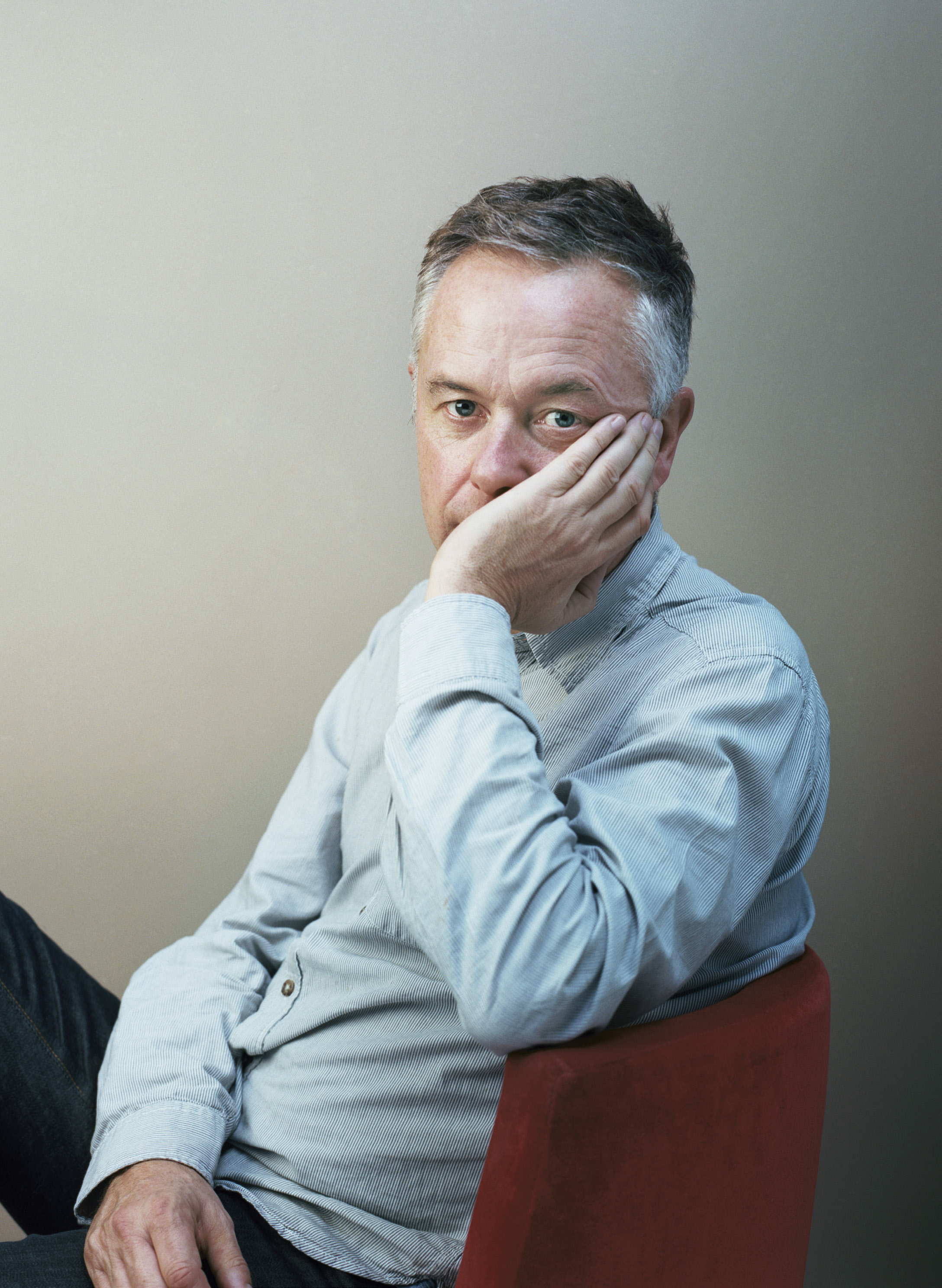
The reason Michael decided to follow Barbie’s advice, he explains, was two-fold: “With fiction you can include certain information that you can’t otherwise, because you have to prove it. But more than that, I felt that the important aspects of the story would get lost in all the details of the real case. If I made a film about the trial of Amanda Knox, then it becomes just that: a film about a trial. I wanted it to be about other things, about love and grief and Dante and family and storytelling.”
Despite the changes in specific details—Perugia becomes Siena, for example—the director asserts that he was still acutely aware of ethical considerations: “Even though we moved everything one step across, the film is as factually accurate as if it had been real. We don’t make up anything.”
The story’s appeal was not the murder itself, but the broader questions it raised about public and press interest in particular types of violent crime. “The idea was maybe we could look at why we all as consumers of the media want to hear about murder trials. There have been at least ten books written about this single case. Many TV documentaries. Endless amount of television and news coverage and articles. That obsession was a story in its own right. Why is a case like this so fascinating? Why has the media tacked on to this one specific story?”
There are salacious and compelling details in all sorts of crimes, but Michael felt that there was something about murder that attracts us. Murder stories, perhaps, fill a space left in society by shifting attitudes towards death. He elaborates: “It’s a weird paradox that we spend so much of our time watching crime and violence on TV, and yet in our own lives death has become almost invisible. All the ways in which people normally experienced death at an intimate, local level with friends and relatives, which was accepted as part of life, we’ve got rid of all that and turned it into drama.”
As he followed those covering the case, the filmmaker saw talented and driven journalists aware that they had to package the story in a way that would sell, to create a version of the trial that would appeal to their newspaper editors. The experience of this persuaded both Michael—and his cinematic proxy Thomas—to go in a different direction. Rather than dramatising Meredith‘s death or Amanda’s trial, The Face of an Angel instead follows Thomas’ creative journey as he debates with journalists and local residents, and struggles to persuade executives more interested in the film’s casting than its themes. Unbeknownst to Thomas, of course, the film that he wants to make is the one he is starring in. While Michael’s preemptive considerations were about the media, both he and Thomas ultimately arrive at the same place: a murdered girl. Where most of the coverage focussed on the young, attractive woman accused of murder, his focus shifts to the one who lost her life, whose family was irreparably damaged by the crime, regardless of who actually perpetrated it.
The Face of an Angel is far from the first of Michael’s films to take inspiration from real life. Out of the 24 features he has directed in his career, five are based on true stories. Even when not directly fact-based, however, his fictional work is similarly defined by an aspiration towards truthfulness. His film Everyday, about a family coping with the father’s prison sentence, was shot in real time over five years, while another effort, 9 Songs, became infamous for depicting a year-long relationship almost entirely through unsimulated sex scenes between its central couple. Michael’s aim is to make events on screen as natural as possible, using whatever techniques will help him do that. When I ask what’s the best sort of atmosphere to engender naturalistic performances, he replies immediately: a chaotic one. “I like people to feel relaxed, and I want to feel comfortable, but obviously I like a bit of chaos,” he says, finishing off his large glass of daytime wine.
Over the course of our fervent, breakneck conversation—he speaks at a rate swift enough to melt all but the hardiest of digital recorders—this comment is perhaps his most redundant. Of course Michael likes chaos. If his propensity for freewheeling impulsiveness wasn’t discernible from his charmingly erratic behaviour before and during our conversation, his wide, wild body of work would give the game away. Arguably the most exciting British filmmaker working today, Michael’s open mind and keen intellectual curiosity seeks restlessly for new ways to tell new stories, and lots of them, too: his 24 films were made over just nineteen years, and he always has a handful of others in varying stages of production.
Michael’s exploratory inclinations are buttressed by the frequent use of improvisation, which he employs for differing purposes, from the comic bickering in his popular series The Trip to recruiting non-professional actors to enact in real life the events of Afghan refugees for In This World. The director speaks with evident delight at the effect that mixing real and fictional elements has on a film. “I like the idea of taking characters and putting them in an environment that’s not controlled, where some people are actors and some aren’t. You know it’s a fiction, but you also know that there are other things going on. The characters aren’t on a set, they’re in the actual world. I remember seeing À Bout de Souffle for the first time, and as they’re walking down the Parisian streets you see someone look at the camera. I love that sort of stuff. It makes it real.”
Published in Oh Comely Issue Twenty-Four. Photograph by Toby Coulson.